Showing posts with label linkage. Show all posts

2.19.2009

Oscar time! Milk buttons! Wrestling! Actors!

by Ryland Walker Knight

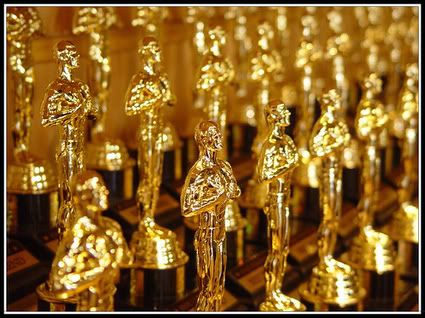
I have only seen two of the nominees for Best Picture this year: David Fincher's The Curious Case of Benjamin Button and Gus Van Sant's Milk. I cannot say I was blown away by either film. I did like parts of both, though. Indeed: both glide by on the charm and movie-star beauty of their respective leads, Brad Pitt and Sean Penn. As the Oscars are wont to do, both men are nominated for Best Actor. Mickey Rourke is also nominated for his performance in The Wrestler. Some have that said Rourke was born to play the role, that his career would have meant nothing had he not been a part of this film, that it's the ne plus ultra of art reflecting life reflecting art works of art. I think it's pretty good. In fact, I'd say that, hyperbole aside, this role does indeed help define Mickey Rourke, and vice-versa. I'll go so far as to say I'm rooting for this man. I might go further to say that outside of Rourke and Werner Herzog (his film, Encounters at the End of the World is nominated for Best Documentary Feature), there's little to draw me to the Oscars this year. I mean, I love looking at Brad Pitt like anybody else but, for serious, he won't be onscreen all night.

Big surprise: Plenty of bloggers are paying way more attention to this year's telecast than I am, and for that I'd like to point you to some of the best:


2.18.2009


— Claire Denis' new film, 35 rhums, opened today in France. It plays four times in New York in mid-March (learn more here) during the Rendez-vous with French cinema series. Please go see it; it's amazing. (More enthusiasm on VINYL.)

so cool, so sexy it hurts

2.16.2009


prez hedz

— some Hitch, via my friend Glenn

no grayscale

— more James Gray, via my friend Claire

2.14.2009

Now in theatres: Two Lovers (James Gray, 2008)

by Ryland Walker Knight

tender

[Many blogs feature review roundups, or use a Friday post to highlight a current release, so this feature is always already redundant. However, we trust, as we push forward, we'll make our way to set ourselves apart from the likes of David Hudson and Aaron Hillis and any other number of committed blogger-critics out in this internetland. Thus, our first installment, an appropriately late entry hitting the web not Thursday or Friday but on Valentine's Day (another genius marketing ploy), as the film is, ostensibly, about "love" or some such nonsense. Also, I haven't seen the film yet.]

ruff

Although available on demand since January 16th, James Gray's Two Lovers opened theatrically on Friday in New York City and Los Angeles. Lucky for this little film, Jaoquin Phoenix has a little act going where he says he's quit acting in favor of a career in hip-hop music. Thursday night, he appeared on The Late Show with David Letterman. It was an instant classic appearance, and had nothing to do with this film, and its noteriety will only help the little PR machine that could behind this modest feature—a film that, from an outsider's eye, looks lovely but (terrifically) out of synch with the current landscape of American Film. For one, it's clearly a straight-forward melodrama. This is apparent in the trailer (see below), despite a few marketing ploys to amp up the Manhattan scenes, and, as Hoberman derides the picture, is consistent with Gray's previous films. Those prior efforts, however, were not romance yarns; rather, all three (just three! in 13 years!) are crime-related tailspins. I did not care for 2007's We Own The Night that much, but it is nothing if not consistent and it definitely had its supporters, like, say, my blogging buddy Zach Campbell (who drops notebook knowledge at Elusive Lucidity) and Dan Callahan at Slant Magazine. And, yes, Callhan has written a fine essay in favor of this new film, again at Slant. His was the first review I read, and it spurred me on to read a number of others, which I hope you do look at as well. I've listed them below in the order I read them in, not in some hierarchy of importance. All of that, coupled with the elegant looking trailer, makes me definitely hope I can see this film sooner rather than later and, if I find the time, revisit his earlier efforts. If there's any benefit to Gray's short-list filmography it's that one may easily digest it in a week. In any case, we hope you enjoy these links, and maybe this film. If you have any thoughts, please do share them.


— Both Glenn Kenny and Karina Longworth saw the film at Cannes and reworked what they wrote then for our reading now. Both are well worth a look.

— Daniel Kasman caught the picture at Cannes as well and has reposted his review at The Auteurs' Notebook alongside a new notice from David Phelps.

— I've already linked to Hoberman's review above but here's another since I like him so much.

— A. O. Scott in the New York Times is his ever-astute and literary self and for Michael Tully at (the handsomely redesigned) /HAMMER TO NAIL, the film proves consistent with what we (okay, I) have come to know of his taste (which is generally excellent, btw).

— Some from some Reverse Shot boys: Andrew Chan, Michael Joshua Rowin, and Elbert Ventura.

— Finally, an "old hat" guy whose new blog career continues to aid the internet's rep as a valuable and interesting forum for criticism (that takes a fun spin on a print "mindset" at that), Salon's Andrew O'Hehir.

2.12.2009

American Filmmaker Links: John Cassavetes


— from the documentary I'm Almost Not Crazy

— Ray Carney on Cassavetes

— An interview with Playboy Magazine, as archived by this website, across 13 pages has this highlight right up front:
Look, this isn't a cop-out—at least I don't think it is—but I tune out directors I hate until I forget their names. I remember all the directors I've ever liked working with as an actor—guys like Don Siegel and Robert Aldrich. The thing I feel directors have to realize today is that they must become like The Beatles: They must write their own material. It's really incredible that directors would allow someone else to write their scripts for them. I can understand that happening when a guy starts out, I suppose, but to make a career out of directing other people's work is all wrong.

— Aquarello, at Strictly Film School, writes on Faces, A Woman Under The Influence, and Love Streams

— Joe Leydon offers this "Lost Interview" from 1985, a time near the end of his life, which touches on his waning, among other things, as when he says, "Not having as much energy is very frustrating. I used to have enormous energy and could accomplish a great deal. Now it takes me a longer period of time to accomplish what I could accomplish in a very, very short time. Outside of that—the rest of it—well, that’s life."

— some aphoristic quotes

— At Senses of Cinema, a few pieces of note by: Matthew Clayfield on Opening Night, Philippe Lubac on Cassavetes and Maurice Pialat, Christos Tsiolkas on three books concerning our hero, Gilberto Perez on two books

— Zach Campbell and Matthew Clayfield offer two "Cassavetes Letters"


— The Criterion Collection Box

2.11.2009

Must-read becomes must-see: When It Was Blue


not blue

— Michael Sicinski in the latest issue of Cinema-Scope, at his best:
Yet it would be entirely too facile to suggest that When It Was Blue is Reeves’ freedom tract, an overcoming of an agoraphobic attitude toward the greater world. For one thing, although Reeves always tends to incorporate some autobiographical elements in her work, she does so in a highly complex, mediated way, and to simply read “Reeves” off the surface of the work is to do both films and maker a grave disservice. Nevertheless, the restlessness and anxiety that permeates When It Was Blue, in particular its engagement with the problem of self and other, the female eye and body making itself genuinely vulnerable in global space, is a feminist and a political issue, and one that expands the mythopoeic achievements of Brakhage in a distinctly grounded, even urgent new direction. (And Brakhage’s work, when reread through Reeves’ “use” of it, has a feminist undercurrent: a disarmed, quivering supplication before the visual universe that abdicates male prerogative, and that ought to give some of his feminist critics reason to reconsider their quick dismissals of his alleged modernist machismo.)

— Jennifer Reeves' website

— the TIFF page for the film

— Sicinski's original notes from TIFF

A quick hit on Philippe Garrel, Van Morrison, and irony


— from 2001's Sauvage Innocence, which looks rather sexy, no?

— here I link to an essay by Quintín, who does not care for the film; he closes his argument against irony thus:
This kind of moral dilemma (“I can make this film against drugs if I help sell drugs”) is at the core of the most primitive Hollywood filmmaking. But something is wrong if a sophisticated director like Garrel indulges himself by messing with this cheap material. In a way, the depiction of intimacy with a twist of irony is a nouvelle vague device that goes back to À bout de souffle (1960). But after all these years, this particular mix of detachment and autobiographical narcissism that gave rise to dandyism has turned sour. In the beginning, there was a world outside and making films was a reaction to it. Now, there is no world left. It's just a matter of solipsism, a game of certain individuals playing with their minds and memories, and a group of admirers celebrating. That's why Sauvage innocence is an empty film.

— having not seen this particular Garrel film, I cannot argue with our man Quintín here; however, I can say that, yes, irony is slippery indeed, and it's rare that it resolves well, but one thing I totally dig about Les amants réguliers is how sincere it all feels... and how smart it is about drug use. I imagine this is consistent in the previous film.

— this dischord makes me yearn to see Sauvage Innocence all the more.

— my favorite piece of writing on Garrel is this piece by Serge Daney, reprinted in English by Rouge.

Artist Spotlight: Pedro Costa

by Ryland Walker Knight

The A+C bio I wrote

     Pedro Costa has made digital works since the turn of the 21st Century due to a number of influences and philosophical premises. Through his 1997 film, Ossos (Bones), Costa shot on film and perfected a style of shadow and elision equal parts Bresson, Rivette, Ford and Tourneur. After working in the Lisbon slums of Fountainhas while filming Ossos, Costa realized the inefficiency and intrusion of a 35mm camera crew, no matter their limited size/footprint. He realized that to work with any grace, any honesty, any integrity, he would have to abandon the troupe of filmmaking. Thus he forsake film’s emulsion for digital’s arrayed pinholes of light and began to shoot his next film, No Quarto de Vanda (In Vanda’s Room), by himself with a “consumer-grade” camera. This was not simply a democratic, or even simply a Marxist, impulse. It’s more complicated, more radical. His new art—in and of the margins—gives face to the mosaic of poverty too rarely seen on cinema screens. It builds the world in blocks of time and space into a concrete object of witness. It’s document without the guile of documentary. It gives us heroes without capes (although they wear masks, as does everybody, the argument goes): the ordinary, made material, exceeds representation.
     Costa’s cinema refuses. As he says, it’s a closed door that leaves you guessing. The impulse to separation is a denial of not just audience identification but the very way of seeing that keeps poverty hidden. It’s a paradox. Pedro Costa looks at the rift and creats a cinema of faith—in the world, in our bondage to it as much as our flight from it. This faith, of course, supercedes politics, however political his image-making may be, into the space of ethics. —How we look is how we make the world.

Some links you might enjoy, or find useful.

— The VINYL IS HEAVY link dump, which will point to essays I've written, as well as some other essays written by other people.
— An impetus for my VIH link dump was Girish's One Stop post, which also prompted Michael Guillen's Next Stop post.
— A Closed Door That Leaves Us Guessing, a lecture Costa delivered that Rouge then published in its 10th issue.
— Andy Rector on Costa over time.
— A clip from his Straub-Huillet video, Où gît votre sourire enfoui?
— His recent The Rabbit Hunters is available for (crummy) viewing on youtube in three parts: one, two and three.
— And! Please, if you want to, help us add more at Pedro's page! Or, as ever, you can send us a link via "curator at artandculture dot com" — or drop it in the comments!

sore

2.10.2009

In the works: Doillon at FIAF.

by Ryland Walker Knight

doillon
criminals

Last Tuesday marked the beginning of the current Jacques Doillon retrospective at French Institute-Alliance Française with a screening of 1985's La Vie de famille, which Dan Salitt says is lovely. I missed it, and I'm bummed. However, I can say that tonight's film, Le petit criminel, is well worth seeing if you happen to live in New York City. I hope to have some words formed about it, and next week's Ponette, for your reading pleasure at The Auteurs' Notebook soon. I'll keep you updated. What's most striking, so far, looking at Doillon's cinema in the order of its programmed appearance at the FIAF, is the focus on children—and their complete "naturalness" in front of the camera. The close-up effaces, or makes transparent, any masks they (wish or hope to) wear. Set mostly in a two-door almost-truck, Le petit criminel is meager, and subtle, a restricted (head) space prone to jammed signals, to cluttered thoughts. The endgame may appear "open" to some but, as the cop says earlier in the picture, there should be no doubt as to where the story winds up; how the angles converge and how the camera pushes into that space (as well as away) define its characteristic (to say, stubborn) resilience. I can only guess how this plays out fuller in La vie de famille, as this trailer below hints at a film teeming with a lot of things I love, like Juliette Binoche, words, language, direct-address, diegetic video use, family problems despite good intentions, life's inherent corruption (and corruptibility), Sami Frey all man-like some 20-plus years after Godard had him dancing all boy-like, and so on; my attraction should become readily apparent as you click play.


Since I'm following the screening schedule, kinda, this puts my viewing of Doillon's films of the 1970s back a bit in my personal queue. This is fine by me, of course, as I've subscribed to a certain curriculum, if you will, but it makes it a little harder to gauge at this point how much similarity his work bears to those of his post-vague filmmaking brethren (the press release mentions Eustache and Garrel to get nerds like me excited) over against a larger tradition of gallic cinema. So far, it seems like he's got more to say to Truffaut and Pialat than those other dudes. More soon. —Oh, and a quick thanks to all the ideas and thoughts thrown my way in that last (now enormous) thread at Girish's joint. [x-posted at VINYL IS HEAVY.]

2.09.2009

evening digital tangents/threads


spray
flakes
a fan

— I just re-read Jean-Baptiste Thoret's essay "Gravity of the Flux: Michael Mann’s Miami Vice" because I just re-read Sally Shafto's recent piece "Brave New World: Some Reflections on the Digital Revolution in General and Digital Cinema in Particular" because just last week I re-watched Miami Vice and I hope to, just as soon as possible, revisit some Jia Zhang-Ke for a long-gestating piece. (Also, for a variety of additional reasons, INLAND EMPIRE.)

— This is, of course, a different model of digital cinema than something like what our own Marc Lafia works at, as you can see on his cinema-engine and on youtube channel and this piece built for The Whitney, but it's kinda cool to think how even in such "non-narrative" works as these the narrative architecture is still at work, still organizing, even if it's work done by spectator and not the spectacle. What I mean to say is that there is a conversation between the traditions that we should perform although we rarely do; weaving is harder than it looks, even in pixel form.

the network

where's che?
wut a drag

— to get some color on here, and repeat-plug our Che Letters at VINYL IS HEAVY; I'm told we can expect Part Three soon...

An anniversary we appreciate: Sátántangó, as noted by Rosenbaum

by Ryland Walker Knight

misty eyed

Béla Tarr's Sátántangó turns 15 this year, apparently, and Jonathan Rosenbaum, one of the film's oldest and most vocal champions, wrote a little ditty at the request of Tarr to help commemorate the moment. His second graf is typically astute:

The film finally became available here last year on DVD from Facets Video, helping to demonstrate how much cinema as a “language” is more easily translatable than literature. For many years, Béla and I have had a running debate about the relation of the film (and, by implication, the novel) to my favorite novel in any language, William Faulkner’s Light in August (1932), which also focuses largely on the simultaneous events of a single day in a depressed, flat rural area as seen through the consciousness of several alienated characters—alienated from themselves as well as from one another—including a fallen patriarch who observes all the others called Reverend Hightower (a name and figure that already anticipates some of the structure and vision of The Man from London), and who might have served as his community’s conscience if they all hadn’t deteriorated into an apocalyptic, post-ethical stupor. Béla doesn’t see any connection because he doesn’t care for the Hungarian translations of Faulkner, and it’s true that one could also trace many of Faulkner’s methods to those of Joseph Conrad. But I also can readily acknowledge that the sarcastic wit of the story is quintessentially that of Eastern Europe.

I was not fortunate enough to see The Man from London when it played in San Francisco and Berkeley as part of last year's San Francisco International FIlm Festival but I have, somehow, seen this other (enormous) thing, and I'm still mostly proud of what I wrote about it, which you can read by clicking this link, for, if any thing, the simple fact that it's a fine marking post for that stage in my development, my taste, my smarts, my life.

man from london

2.07.2009

Film Blog of Note #1: The House Next Door

by Ryland Walker Knight

[Here begins a short series on the blogs we've chosen to add to the "Blogs of Note" section of the Art+Culture Film Magazine landing page, a pageflakes-like assemblage of RSS feeds, which we are continuing to tweak in this beta phase. We should note, in addition, that we are open to suggestions!]


While I understand that there is a certain conflict of interest in promoting another outlet I write for (on occasion), I feel this is a necessary nod as Matt Zoller Seitz and Keith Uhlich are largely responsible for my first exposure to the broader blogosphere. VINYL IS HEAVY attracted a few stragglers when it began, but it wasn't until I began writing (and sporadically at that) for The House that anybody really paid attention to what weird words I wrote. So this first spotlight is a thank you. Also, Matt's baby, which has matured in three years into Keith's angsty teen (dog years? mixed metaphors?), is kind of a big deal now'a'daze so this link is possibly redundant. Then again, all in this series probably will be since this little thing I've started is going to be read by very few people as we build up our base.

In any event, The House Next Door has blossomed into one of the premiere online film blogs, acting as host to a wide stable of young writers (and some not-so-young writers) eager to share their particular perspectives and passions. What began as a platform to sing praises about Terrence Malick's The New World, now affords space to television and music and, even, last fall, some political intrigue on top of the continued interest in cinema. And it continues to morph and build into something new, like any home, as it welcomes more and more readers and writers. Visit the lively comments sections for often funny and definitely irreverent opines and rants, arguments and shouts, all kinds of ideas. If only we could get Keith to write more often and get Matt back into writing at all, we would be in even better shape as fans and curious readers and friends alike. Finally, a bit of self-promo to top it off: To mark the anniversary of the site this new year, Keith and I composed a pean, of sorts, to the site and to that Malick film, and how both have shaped our trajectories, which you can read by clicking this link right here.

alone

2.01.2009


cotillard

From Arnaud Desplechin's Comment je me suis disputé (ma vie sexuelle...), which I wrote about last fall right here and you can watch on The Auteurs right here.