Showing posts with label American Film. Show all posts
3.09.2009
2.25.2009
— Francis Ford Coppola has a new film called Tetro (film site), for which FFC has just launched a website. There are a few pictures from the film, as seen above, and a video made by Francis himself (what some may call a vlog) introducing the project. The film stars Vincent Gallo and is the first original screenplay Coppola has shot since 1974's The Conversation, which is a personal favorite of mine.
Labels:
American Film,
Francis Ford Coppola,
Vincent Gallo
2.21.2009
— Hugh Jackman's prep work for hosting the Oscars. Lots of man there. I hope I'm never that buff.
Labels:
American Film,
Hugh Jackman,
International Film,
Oscars
2.19.2009
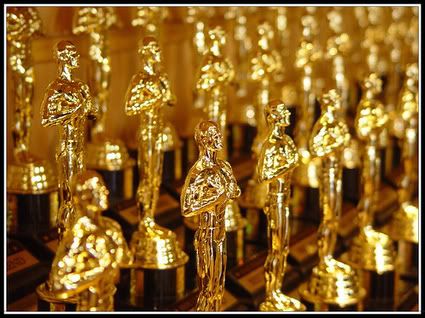
Oscar time! Milk buttons! Wrestling! Actors!
I have only seen two of the nominees for Best Picture this year: David Fincher's The Curious Case of Benjamin Button and Gus Van Sant's Milk. I cannot say I was blown away by either film. I did like parts of both, though. Indeed: both glide by on the charm and movie-star beauty of their respective leads, Brad Pitt and Sean Penn. As the Oscars are wont to do, both men are nominated for Best Actor. Mickey Rourke is also nominated for his performance in The Wrestler. Some have that said Rourke was born to play the role, that his career would have meant nothing had he not been a part of this film, that it's the ne plus ultra of art reflecting life reflecting art works of art. I think it's pretty good. In fact, I'd say that, hyperbole aside, this role does indeed help define Mickey Rourke, and vice-versa. I'll go so far as to say I'm rooting for this man. I might go further to say that outside of Rourke and Werner Herzog (his film, Encounters at the End of the World is nominated for Best Documentary Feature), there's little to draw me to the Oscars this year. I mean, I love looking at Brad Pitt like anybody else but, for serious, he won't be onscreen all night.
Big surprise: Plenty of bloggers are paying way more attention to this year's telecast than I am, and for that I'd like to point you to some of the best:
- Ali Arikan plans on liveblogging the event
- Count on Defamer to have plenty to blog about in all their snarky glory
- Craig Phillips and Aaron Hillis will liveblog on Sunday for GreenCine
- Karina Longworth shall Twitter through Sunday for Spout, covering both the Independent Spirit Awards on Saturday and the Oscars proper on Sunday
- Nathaniel R of The Film Experience and a select crew are hosting the 4th Annual Oscar Symposium
- You can bet Jeffrey Wells will have something to say
Labels:
American Film,
Brad Pitt,
David Fincher,
Gus Van Sant,
International Film,
linkage,
Oscars,
Sean Penn
2.16.2009
Labels:
Alfred Hitchcock,
American Film,
Cary Grant,
images,
linkage
Labels:
American Film,
James Gray,
linkage,
poster
2.14.2009
Now in theatres: Two Lovers (James Gray, 2008)
by Ryland Walker Knight

[Many blogs feature review roundups, or use a Friday post to highlight a current release, so this feature is always already redundant. However, we trust, as we push forward, we'll make our way to set ourselves apart from the likes of David Hudson and Aaron Hillis and any other number of committed blogger-critics out in this internetland. Thus, our first installment, an appropriately late entry hitting the web not Thursday or Friday but on Valentine's Day (another genius marketing ploy), as the film is, ostensibly, about "love" or some such nonsense. Also, I haven't seen the film yet.]

Although available on demand since January 16th, James Gray's Two Lovers opened theatrically on Friday in New York City and Los Angeles. Lucky for this little film, Jaoquin Phoenix has a little act going where he says he's quit acting in favor of a career in hip-hop music. Thursday night, he appeared on The Late Show with David Letterman. It was an instant classic appearance, and had nothing to do with this film, and its noteriety will only help the little PR machine that could behind this modest feature—a film that, from an outsider's eye, looks lovely but (terrifically) out of synch with the current landscape of American Film. For one, it's clearly a straight-forward melodrama. This is apparent in the trailer (see below), despite a few marketing ploys to amp up the Manhattan scenes, and, as Hoberman derides the picture, is consistent with Gray's previous films. Those prior efforts, however, were not romance yarns; rather, all three (just three! in 13 years!) are crime-related tailspins. I did not care for 2007's We Own The Night that much, but it is nothing if not consistent and it definitely had its supporters, like, say, my blogging buddy Zach Campbell (who drops notebook knowledge at Elusive Lucidity) and Dan Callahan at Slant Magazine. And, yes, Callhan has written a fine essay in favor of this new film, again at Slant. His was the first review I read, and it spurred me on to read a number of others, which I hope you do look at as well. I've listed them below in the order I read them in, not in some hierarchy of importance. All of that, coupled with the elegant looking trailer, makes me definitely hope I can see this film sooner rather than later and, if I find the time, revisit his earlier efforts. If there's any benefit to Gray's short-list filmography it's that one may easily digest it in a week. In any case, we hope you enjoy these links, and maybe this film. If you have any thoughts, please do share them.
— Both Glenn Kenny and Karina Longworth saw the film at Cannes and reworked what they wrote then for our reading now. Both are well worth a look.
— Daniel Kasman caught the picture at Cannes as well and has reposted his review at The Auteurs' Notebook alongside a new notice from David Phelps.
— I've already linked to Hoberman's review above but here's another since I like him so much.
— A. O. Scott in the New York Times is his ever-astute and literary self and for Michael Tully at (the handsomely redesigned) /HAMMER TO NAIL, the film proves consistent with what we (okay, I) have come to know of his taste (which is generally excellent, btw).
— Some from some Reverse Shot boys: Andrew Chan, Michael Joshua Rowin, and Elbert Ventura.
— Finally, an "old hat" guy whose new blog career continues to aid the internet's rep as a valuable and interesting forum for criticism (that takes a fun spin on a print "mindset" at that), Salon's Andrew O'Hehir.
[Many blogs feature review roundups, or use a Friday post to highlight a current release, so this feature is always already redundant. However, we trust, as we push forward, we'll make our way to set ourselves apart from the likes of David Hudson and Aaron Hillis and any other number of committed blogger-critics out in this internetland. Thus, our first installment, an appropriately late entry hitting the web not Thursday or Friday but on Valentine's Day (another genius marketing ploy), as the film is, ostensibly, about "love" or some such nonsense. Also, I haven't seen the film yet.]
Although available on demand since January 16th, James Gray's Two Lovers opened theatrically on Friday in New York City and Los Angeles. Lucky for this little film, Jaoquin Phoenix has a little act going where he says he's quit acting in favor of a career in hip-hop music. Thursday night, he appeared on The Late Show with David Letterman. It was an instant classic appearance, and had nothing to do with this film, and its noteriety will only help the little PR machine that could behind this modest feature—a film that, from an outsider's eye, looks lovely but (terrifically) out of synch with the current landscape of American Film. For one, it's clearly a straight-forward melodrama. This is apparent in the trailer (see below), despite a few marketing ploys to amp up the Manhattan scenes, and, as Hoberman derides the picture, is consistent with Gray's previous films. Those prior efforts, however, were not romance yarns; rather, all three (just three! in 13 years!) are crime-related tailspins. I did not care for 2007's We Own The Night that much, but it is nothing if not consistent and it definitely had its supporters, like, say, my blogging buddy Zach Campbell (who drops notebook knowledge at Elusive Lucidity) and Dan Callahan at Slant Magazine. And, yes, Callhan has written a fine essay in favor of this new film, again at Slant. His was the first review I read, and it spurred me on to read a number of others, which I hope you do look at as well. I've listed them below in the order I read them in, not in some hierarchy of importance. All of that, coupled with the elegant looking trailer, makes me definitely hope I can see this film sooner rather than later and, if I find the time, revisit his earlier efforts. If there's any benefit to Gray's short-list filmography it's that one may easily digest it in a week. In any case, we hope you enjoy these links, and maybe this film. If you have any thoughts, please do share them.
— Both Glenn Kenny and Karina Longworth saw the film at Cannes and reworked what they wrote then for our reading now. Both are well worth a look.
— Daniel Kasman caught the picture at Cannes as well and has reposted his review at The Auteurs' Notebook alongside a new notice from David Phelps.
— I've already linked to Hoberman's review above but here's another since I like him so much.
— A. O. Scott in the New York Times is his ever-astute and literary self and for Michael Tully at (the handsomely redesigned) /HAMMER TO NAIL, the film proves consistent with what we (okay, I) have come to know of his taste (which is generally excellent, btw).
— Some from some Reverse Shot boys: Andrew Chan, Michael Joshua Rowin, and Elbert Ventura.
— Finally, an "old hat" guy whose new blog career continues to aid the internet's rep as a valuable and interesting forum for criticism (that takes a fun spin on a print "mindset" at that), Salon's Andrew O'Hehir.
Labels:
American Film,
James Gray,
linkage,
Now in theatres
2.12.2009
American Filmmaker Links: John Cassavetes
— from the documentary I'm Almost Not Crazy
— Ray Carney on Cassavetes
— An interview with Playboy Magazine, as archived by this website, across 13 pages has this highlight right up front:
Look, this isn't a cop-out—at least I don't think it is—but I tune out directors I hate until I forget their names. I remember all the directors I've ever liked working with as an actor—guys like Don Siegel and Robert Aldrich. The thing I feel directors have to realize today is that they must become like The Beatles: They must write their own material. It's really incredible that directors would allow someone else to write their scripts for them. I can understand that happening when a guy starts out, I suppose, but to make a career out of directing other people's work is all wrong.
— Aquarello, at Strictly Film School, writes on Faces, A Woman Under The Influence, and Love Streams
— Joe Leydon offers this "Lost Interview" from 1985, a time near the end of his life, which touches on his waning, among other things, as when he says, "Not having as much energy is very frustrating. I used to have enormous energy and could accomplish a great deal. Now it takes me a longer period of time to accomplish what I could accomplish in a very, very short time. Outside of that—the rest of it—well, that’s life."
— some aphoristic quotes
— At Senses of Cinema, a few pieces of note by: Matthew Clayfield on Opening Night, Philippe Lubac on Cassavetes and Maurice Pialat, Christos Tsiolkas on three books concerning our hero, Gilberto Perez on two books
— Zach Campbell and Matthew Clayfield offer two "Cassavetes Letters"
— The Criterion Collection Box
Labels:
American Film,
John Cassavetes,
linkage
2.11.2009
10 Personal Touchstones in American Cinema
by Ryland Walker Knight


Here I shall list ten films, always that arbitrary arbiter, that have directed my thought (or marked certain passages) in the most significant ways during my young life in the cinema. I list them here in chronological order of their impression on my forever impressionable brain.
Mean Streets, Martin Scorsese, 1973
The first film to show me how much music matters, and the first film I can remember feeling aroused by during its violence. Luckily, it still feels "strong" and, as I age, it appreciates for different and exciting reasons. As with all that follow, it continues to teach me things.
Manhattan, Woody Allen, 1979
Woody taught me to look beyond the center of the frame for the first time, and that Gershwin still matters, even in fantasy-land. Honestly? I could easily have put The Godfather: Part II here for similar reasons tied to Gordon Willis.
2001: A Space Odyssey, Stanley Kubrick, 1968
It feels a little dishonest to place this film this early in my personal timeline but, as I said with the Scorsese above, this film continues to yield new sights with every screening. Seeing it for the first time in 70mm at the Castro Theatre in San Francisco was perhaps the greatest cinema experience I can remember as it fulfilled every desire this always-learning young cinephile could think of; a year later it did new things. Since then I have yet to look at it at home. It's a cathedral unto itself. (Also, does it belong in American Film? You tell me. It's so seminal that I felt I had to squeeze it in.)
The Birds, Alfred Hitchcock, 1963
My chosen banner image should have alerted you to the possibility of this choice, of course, and, again, this film did not tell me all it could and would when first I saw Tippi's cheekbones cringe in terror. Now it's easily my favorite Hitch for more than just my undying affection for the wounded soul underneath that blithe, aloof facade Ms Hedren erects. For instance: the lack of score! the crisp editing! the untidy psychology! the unreliability of the signifier! (Here I'm assuming that a Hollywood film by an English director will count for an American Film.)
Rushmore, Wes Anderson, 1998
Encountered late in high school, and after first seeing The Graduate, this update (of sorts) on that Nichols-Hoffman classic meant a lot to my sensitive desire to be loved as I am, just like any number of myopic teenagers. However, it still makes me laugh, and, as I learned a few other things from films below this one on this list, it has plenty to offer—just like its star character.
Mulholland Dr, David Lynch, 2001
Saw this one five times in theatres. Didn't know what to do with it other than tell everybody I thought it the most brilliant thing ever. It took me a good six years to really grasp what I sensed. And then INLAND EMPIRE came out...
The Conversation, Francis Ford Coppola, 1974
Seen anew after reading Walter Murch and Michael Ondaatje's book, The Conversations, this was as big in teaching me how to "look" at a film's sound as was the Lynch I mention just above.
The New World, Terrence Malick, 2005
As I wrote in this recent piece for The House Next Door, this is perhaps the most important film for my development as a person invested in cinema (as a viewer, as a writer, as a thinker).
The Awful Truth, Leo McCarey, 1937
Encountered in conjunction with my first exposure to Stanley Cavell's extraordinary (and extraordinarily influential) The Pursuits of Happiness, it was unavoidable I would fall in love with all this lovely thing has to offer. It may not be as "good" as a few others Cavell writes about in that book, but, as it is the final film discussed, its significance is weighted that much more by all that precedes it one's life with the book (and films), or had preceded it mine.
On Dangerous Ground, Nicholas Ray, 1952
A helluva lesson in phenomenology. I need to see it again so I can write more. Also: a helluva lesson that Nick Ray does, in fact, live up to Godard's proclamation (about Bitter Victory): this is cinema.

I'm certain your trajectories will teach me things in turn! So, please, share yours in the comments! Or, if you like, at your own blogs!
Here I shall list ten films, always that arbitrary arbiter, that have directed my thought (or marked certain passages) in the most significant ways during my young life in the cinema. I list them here in chronological order of their impression on my forever impressionable brain.
Mean Streets, Martin Scorsese, 1973
The first film to show me how much music matters, and the first film I can remember feeling aroused by during its violence. Luckily, it still feels "strong" and, as I age, it appreciates for different and exciting reasons. As with all that follow, it continues to teach me things.
Manhattan, Woody Allen, 1979
Woody taught me to look beyond the center of the frame for the first time, and that Gershwin still matters, even in fantasy-land. Honestly? I could easily have put The Godfather: Part II here for similar reasons tied to Gordon Willis.
2001: A Space Odyssey, Stanley Kubrick, 1968
It feels a little dishonest to place this film this early in my personal timeline but, as I said with the Scorsese above, this film continues to yield new sights with every screening. Seeing it for the first time in 70mm at the Castro Theatre in San Francisco was perhaps the greatest cinema experience I can remember as it fulfilled every desire this always-learning young cinephile could think of; a year later it did new things. Since then I have yet to look at it at home. It's a cathedral unto itself. (Also, does it belong in American Film? You tell me. It's so seminal that I felt I had to squeeze it in.)
The Birds, Alfred Hitchcock, 1963
My chosen banner image should have alerted you to the possibility of this choice, of course, and, again, this film did not tell me all it could and would when first I saw Tippi's cheekbones cringe in terror. Now it's easily my favorite Hitch for more than just my undying affection for the wounded soul underneath that blithe, aloof facade Ms Hedren erects. For instance: the lack of score! the crisp editing! the untidy psychology! the unreliability of the signifier! (Here I'm assuming that a Hollywood film by an English director will count for an American Film.)
Rushmore, Wes Anderson, 1998
Encountered late in high school, and after first seeing The Graduate, this update (of sorts) on that Nichols-Hoffman classic meant a lot to my sensitive desire to be loved as I am, just like any number of myopic teenagers. However, it still makes me laugh, and, as I learned a few other things from films below this one on this list, it has plenty to offer—just like its star character.
Mulholland Dr, David Lynch, 2001
Saw this one five times in theatres. Didn't know what to do with it other than tell everybody I thought it the most brilliant thing ever. It took me a good six years to really grasp what I sensed. And then INLAND EMPIRE came out...
The Conversation, Francis Ford Coppola, 1974
Seen anew after reading Walter Murch and Michael Ondaatje's book, The Conversations, this was as big in teaching me how to "look" at a film's sound as was the Lynch I mention just above.
The New World, Terrence Malick, 2005
As I wrote in this recent piece for The House Next Door, this is perhaps the most important film for my development as a person invested in cinema (as a viewer, as a writer, as a thinker).
The Awful Truth, Leo McCarey, 1937
Encountered in conjunction with my first exposure to Stanley Cavell's extraordinary (and extraordinarily influential) The Pursuits of Happiness, it was unavoidable I would fall in love with all this lovely thing has to offer. It may not be as "good" as a few others Cavell writes about in that book, but, as it is the final film discussed, its significance is weighted that much more by all that precedes it one's life with the book (and films), or had preceded it mine.
On Dangerous Ground, Nicholas Ray, 1952
A helluva lesson in phenomenology. I need to see it again so I can write more. Also: a helluva lesson that Nick Ray does, in fact, live up to Godard's proclamation (about Bitter Victory): this is cinema.
I'm certain your trajectories will teach me things in turn! So, please, share yours in the comments! Or, if you like, at your own blogs!
Subscribe to:
Posts (Atom)